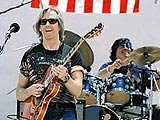
Look, Carlos Santana is a legend. And he truly has created some of the most memorable guitar lines in history. Unfortunately, very few of them are in evidence on this album, Santana's Guitar Heaven.
Consisting of songs by The Doors, The Rolling Stones, The Beatles, Def Leppard, Deep Purple and other iconic bands, these tracks represent some of the most memorable guitar driven-songs in rock 'n roll history. So why would Carlos Santana choose to re-do them? There really is only one answer that makes sense:
Marketing.
If you really stretch, you could rationalize that Santana — by coupling young, current lead singers with classic rock songs — is introducing said songs to a younger generation. There's only one problem with that: those songs need no introduction to any generation.
Years ago, when uber-chops players were king, when Steve Vai and Joe Satriani were all the rage (don't get me wrong, they both are phenomenal players), a number of focus groups asked "young" people (11 to 22) who their favorite guitar players were. You know who they chose?
In no particular order:
Jimi Hendrix
Eric Clapton
Jimmy Page
Hmmmmm . . . It seems that "classic" rock is both alive and well — to listeners at any age. In that case, other than sales figures, there really was no good reason to deliver versions that are, at best, adequate, and, at worst, anemic, of these anthemic songs. With one exception:
"While My Guitar Gently Weeps"
This is a great song that, in this writer's opinion, is not usually given its due by the many talented six-string slingers that have attempted it. However, on this one track, Carlos Santana actually captures the flavor of the song in a way that totally fits the song itself.
Why?
Because, as he did in days of old, Carlos actually complements the flavor of the song. He celebrates the very "minor"-ness of it — something that is often sidestepped. In addition to this, the brilliant decisions to bring in both cellist extraordinaire Yo Yo Ma, and soulful pop vocalist Indie.Arie, were made. Both of which highlighted the haunting harmony and melody of this piece — one of George Harrison's best.
So, for his brilliant rendition of the Beatles classic, bravo! It's nice to hear that the Latin-rock legend still has some magic up his sleeve, and proves, once again, why he has become the legend he is.
Saturday, May 28, 2011

Tuesday, March 15, 2011
Latin Rock Music, Part 5
My Writing Process, Part 5
 For rhythm or chordal roles, I stick with simple 2- and 3-note chords (often octaves or root-fifth inversions), and play a sparse pattern that creates a rhythmic counterpoint with the other instruments.
Since there is no roadmap (that I know of) for writing guitar parts like this, it often takes a frustrating amount of experimentation before I happen upon something that works. However, over time, it has gotten a bit easier.
Creating a Latin Rock Groove
 Traditional Latin bands don't usually have a "kit" drummer. Instead, the combination of Timbales, Congas, and hand percussion forms a rhythmic tapestry that drives the music. However, Latin Rock dictates a heavy sound with a classic drum set. To make that work, you need to a drummer that knows how to play an open groove so that the percussion has room (our drummer happens to be very good at it -- a lucky break for us).
In addition, since the music we're playing has a rock flavor to it, the grooves are different than standard Latin grooves. So, there are a few basic formulas I use to create a groove.
1) Build it step by step. Starting with vocals, then the various instrumental lines, we experiment with various feels until we find one that works. Sometimes this takes a while!
2) Avoid guitar "strumming." It's so easy to play a typical rhythmic chord pattern on the guitar. Unfortunately, it seldom adds anything to the arrangement. When not playing melodies or arpeggiations ("montuno"), I pick unusual intervals and triads and focus on creating an open, distinctive rhythm. Often, this happens at the end, after the rest of the band figures out their parts.
3) Don't be afraid to "lay out." As musicians, we're used to playing every measure of every song. It's just habit. If a certain instrument is not needed in a certain part, don't force it! Just leave it out.
Tuesday, March 8, 2011
Latin Rock Music, Part 4
My Writing Process, Part 4
Hooks Don't Have to Be Just Melodies
 One of the lessons I've learned about arrangements is that hooks can -- and should -- occur anywhere in a song. Sure, the most important one is the chorus melody (and lyric) that listeners can remember. But a cool guitar riff, a simple synth line; even a drum groove or percussion fill can be a hook.
Once the song is "written," the challenge during the process of arranging is to create and refine those hooks throughout the song. As players, you often have to "step back" from the music, and hear it like a non-musician listener would. A simple break that seems elementary to you may be just the thing that gets an audience pumped.
Other Songwriting Techniques
In the vein of song writing techniques, I have another that may not be that common: I don't record any part of a song until we're actually working on the full arrangement with the band. Seem crazy? It works for me, and here's why:
Once a song, or even just an idea, gets recorded, it makes it more difficult for me to adapt it. As a writer, I'm constantly editing and refining what I do, so that as I'm creating a song, it's gradually evolving. In fact, one important part of this process is mistakes. In playing something, if I make a mistake that happens to sound cool, I incorporate it!
The other reason is that I find it difficult to focus my energy on the writing process at the same time as the recording process. If I try to do them simultaneously, one or both of them suffers.
 Fitting Rock Guitar Into Latin Music
Since my inspiration is not Santana but rather more traditional Latin music, having the guitar serve as a prime instrument is an obstacle. In these genres, the roles are very defined:
- Piano plays the "montuno," or repetitive syncopated chord arpeggiations. This carries the harmony.
- Bass plays a sparse, angular pattern that avoids the "one" beat like the plague. This helps to set the rhythmic tone.
- Horns play the lead lines, and add chordal stabs, swells, and other effects. Thus creating -- other than the vocals -- the key melodic components.
- Guitar, when it is used, generally plays a supporting chordal rhythm pattern, and is pretty much in the background.
So, how does someone who grew up playing rock "lead" guitar fit it into a Latin format? Fat, overdriven guitar can work for playing melodies, but not in the way that a trumpet or a horn section can. To make the guitar work in a lead role, I utilize several techniques:
1) When we need horn "stabs," the keyboards cover them, and I play a montuno-like pattern on the guitar.
2) In order to achieve simple, trumpet-like melodic lines, I have the vocalist or a synthesizer double the line with me, in addition to utilizing doubled guitar technique (one bent note matching a straight note).
3) I employ playing techniques to enhance simple lines, such as bends, slides up or down, and unique, syncopated rhythmic phrasing.
Hooks Don't Have to Be Just Melodies
 One of the lessons I've learned about arrangements is that hooks can -- and should -- occur anywhere in a song. Sure, the most important one is the chorus melody (and lyric) that listeners can remember. But a cool guitar riff, a simple synth line; even a drum groove or percussion fill can be a hook.
Once the song is "written," the challenge during the process of arranging is to create and refine those hooks throughout the song. As players, you often have to "step back" from the music, and hear it like a non-musician listener would. A simple break that seems elementary to you may be just the thing that gets an audience pumped.
Other Songwriting Techniques
In the vein of song writing techniques, I have another that may not be that common: I don't record any part of a song until we're actually working on the full arrangement with the band. Seem crazy? It works for me, and here's why:
Once a song, or even just an idea, gets recorded, it makes it more difficult for me to adapt it. As a writer, I'm constantly editing and refining what I do, so that as I'm creating a song, it's gradually evolving. In fact, one important part of this process is mistakes. In playing something, if I make a mistake that happens to sound cool, I incorporate it!
The other reason is that I find it difficult to focus my energy on the writing process at the same time as the recording process. If I try to do them simultaneously, one or both of them suffers.
 Fitting Rock Guitar Into Latin Music
Since my inspiration is not Santana but rather more traditional Latin music, having the guitar serve as a prime instrument is an obstacle. In these genres, the roles are very defined:
- Piano plays the "montuno," or repetitive syncopated chord arpeggiations. This carries the harmony.
- Bass plays a sparse, angular pattern that avoids the "one" beat like the plague. This helps to set the rhythmic tone.
- Horns play the lead lines, and add chordal stabs, swells, and other effects. Thus creating -- other than the vocals -- the key melodic components.
- Guitar, when it is used, generally plays a supporting chordal rhythm pattern, and is pretty much in the background.
So, how does someone who grew up playing rock "lead" guitar fit it into a Latin format? Fat, overdriven guitar can work for playing melodies, but not in the way that a trumpet or a horn section can. To make the guitar work in a lead role, I utilize several techniques:
1) When we need horn "stabs," the keyboards cover them, and I play a montuno-like pattern on the guitar.
2) In order to achieve simple, trumpet-like melodic lines, I have the vocalist or a synthesizer double the line with me, in addition to utilizing doubled guitar technique (one bent note matching a straight note).
3) I employ playing techniques to enhance simple lines, such as bends, slides up or down, and unique, syncopated rhythmic phrasing.
Tuesday, March 1, 2011
Latin Rock Music, Part 3
My Writing Process, Part 3
 These days, other than a style called "singer-songwriter" (think coffee shop, single performer with a guitar or piano), arrangment is such an integral part of music that it seems bare without it. And, a well-done arrangment can make or break a song. This is definitely an arena in which Santana excels. To me, the epitome is "Jingo," a song from Santana's first album (sometimes called Santana by Santana).
Jingo has -- are you ready? -- one chord. One! Lyrically, it's almost as spare: it has three syllables. Not words, syllables! But even given this dearth of elements, it is an interesting song that draws you in and keeps you interested. How? The arrangement is clever and subtle, using diverse elements that build excitement and keep the song moving.
Songwriting Traps and Pitfalls
Having worked in the industry and around musicians for so many years, I'm pretty familiar with some of the pitfalls all songwriters face. To me, the most dangerous one is lack of self-evaluation.
Be Your Own Worst Critic
Look, songwriting can be learned and improved upon, just like any other skill. But in order to get better, you have to be willing to critique your own work. When I'm crafting a song, I'm constantly asking myself these questions:
- Is this part really needed? Is it adding to the whole, or just a diversion?
- Is each melody compelling? Does it make you want to hum along, and is it memorable? Or is it just an exercise in musical technique?
- Could this part be stronger? How?
 Working the Songs Out In Rehearsal
When I started this project, one of the rules I had was: every song had to be worked out and played "live." I did that for several reasons:
1) How many times have you gone to see a band and been disappointed in their live sound as compared to their recorded sound? I didn't want our band to be guilty of that;
2) In the studio, it's easy to cover up a song's deficiencies by adding more tracks, thickening it with layers, etc. But live, you can't do any of that. If a part isn't working, you simply have to write a better part!
3) Having limited instruments makes you focus on the melody more. Why? Because if you only have one instrument to play the melody, or if two instruments play the melody and only the bass player is carrying the harmony, the melody better be pretty damn strong!
Having these limitations forced me -- as a songwriter -- to write competent melodies that stood on their own. Or keep trying until I did!
Monday, February 28, 2011
Latin Rock Music, Part 2
My Writing Process, Part 2
Breaking the Patterns
 When it does come time to write the chords to the song, I'll try to avoid the typical 4-chord progression, where each chord lasts for the same length of time. One way is to simply vary the amount of measures each chord lasts. Or, you can go back and forth between two chords; then when you introduce additional chords, they have drama.
 Another "trick" I use is to change the chords at unexpected times. For instance, if your verse was based on two chords, it might go like this:
Chord 1 | Chord 1 | Chord 2 | Chord 2 | repeat
But what if you change in different spots? Like this:
Chord 1 | Chord 2 | Chord 2 | Chord 1 | repeat
It seems like a simple modification, but what it does is to put the changes where you don't expect, and keep the chord the same where you might expect a change. It's all about breaking the pattern.
Getting Feedback, and Listening
One of the big advantages of having a working band like Savor, is that when playing as a Santana Tribute Band, we can throw in our own songs, too. As long as the songs fit the style (Latin Rock), many people don't know they're original. After all, beyond the classic hits: Oye Como Va, Black Magic Woman, Evil Ways, Smooth, Europa, and a few others, most people are not familiar with Santana's catalog.
 When you play an original song like that for people who have never heard it, the reaction is honest, and, often, brutal. My rule of thumb was: play the song for a few different audiences. If they didn't react (dancing, nodding their heads, clapping enthusiastically afterwards), I knew I hadn't done my job as a writer. I would make changes, reintroduce it to audiences, and keep doing that until I did get a positive reaction.
Frustrating? Yes. Sometimes I think the players in the band consider me a bit loony -- especially after I had re-written one of the songs three times during the course of a couple of years! But in the end, I really believe that we wound up with a stronger, more effective song. After all, the purpose of songwriting is to reach people, right?
Writing vs. Arranging
This is sometimes difficult to explain to non-musicians, and in fact the lines blur. The way I think of it is, the basic, stripped-down lyrics (if it's a vocal song), melody and chord progression together make up the song writing.
What the bass player does, how the drums interact with the percussion, the guitar riffs that go under and in between everything else -- that's the arrangement.
Monday, February 21, 2011
Latin Rock Music, Part 1
My Writing Process, Part 1
Due to the widespread popularity of Amadeus, the movie based on Mozart's life, it's well known that Mozart was a prolific composer -- the music pouring out of him as if by magic.
 In more modern times, The Beatles, Paul Simon, Elton John, Prince, and others, seem to be able to create songs at a breakneck pace. Not so with me. (And, from what I've learned, with many other songwriters as well.) In fact, I feel that I am not so much a song writer as a song crafter. I often work for days, weeks or months developing a song, before I'm satisfied.
Over the years my writing methods have changed, but one of the most drastic changes occurred about 10 years ago. I was watching a well-known songwriter speak, and he said that he would start by writing melodies with no instrumental accompaniment at all. Huh? But as he explained, I began to understand: it is the melody that most people connect with, that most listeners remember, that audiences identify and sing along to.
The Songwriting Rut
After that, I began to see the patterns that I -- and, as far as I can tell, many songwriters -- fall back on. It goes like this: using a harmonic instrument (usually guitar or keyboard), write a chord progression. And, what's more, make that chord progression consist of four chords, lasting one measure each. For example: Chord 1 | Chord 2 | Chord 3 | Chord 4 | repeat.
(If you start analyzing songs you hear, especially songs by amateur, independent or "unsigned bands," you'll begin to see that this is an amazingly common formula.)
Next, fit a melody to the chords. That's a trap, because while it's pretty easy to make a melody work with a chord progression, it's much more difficult to write a melody that stands on its own. However, that lack of melodic power is often disguised by its interaction with the chord progression.
 Breaking the Pattern
How do I avoid that songwriting quagmire? I have several methods, and I'm sure many songwriters have their own tricks. First, as I mentioned, whether I'm writing an instrumental song where the guitar plays the melody, or writing a vocal song, I create the melody on its own. If it doesn't work on its own, I keep re-writing it until it does.
Another technique I use is to write songs in unusual keys. (This drives our keyboard player crazy, such as when I present a song written in Eb minor -- a very difficult key to play in!) But there's method to my madness: instrumentalists tend to go to familiar places when playing in common keys; without those crutches, we're more likely to create something new.
Due to the widespread popularity of Amadeus, the movie based on Mozart's life, it's well known that Mozart was a prolific composer -- the music pouring out of him as if by magic.
 In more modern times, The Beatles, Paul Simon, Elton John, Prince, and others, seem to be able to create songs at a breakneck pace. Not so with me. (And, from what I've learned, with many other songwriters as well.) In fact, I feel that I am not so much a song writer as a song crafter. I often work for days, weeks or months developing a song, before I'm satisfied.
Over the years my writing methods have changed, but one of the most drastic changes occurred about 10 years ago. I was watching a well-known songwriter speak, and he said that he would start by writing melodies with no instrumental accompaniment at all. Huh? But as he explained, I began to understand: it is the melody that most people connect with, that most listeners remember, that audiences identify and sing along to.
The Songwriting Rut
After that, I began to see the patterns that I -- and, as far as I can tell, many songwriters -- fall back on. It goes like this: using a harmonic instrument (usually guitar or keyboard), write a chord progression. And, what's more, make that chord progression consist of four chords, lasting one measure each. For example: Chord 1 | Chord 2 | Chord 3 | Chord 4 | repeat.
(If you start analyzing songs you hear, especially songs by amateur, independent or "unsigned bands," you'll begin to see that this is an amazingly common formula.)
Next, fit a melody to the chords. That's a trap, because while it's pretty easy to make a melody work with a chord progression, it's much more difficult to write a melody that stands on its own. However, that lack of melodic power is often disguised by its interaction with the chord progression.
 Breaking the Pattern
How do I avoid that songwriting quagmire? I have several methods, and I'm sure many songwriters have their own tricks. First, as I mentioned, whether I'm writing an instrumental song where the guitar plays the melody, or writing a vocal song, I create the melody on its own. If it doesn't work on its own, I keep re-writing it until it does.
Another technique I use is to write songs in unusual keys. (This drives our keyboard player crazy, such as when I present a song written in Eb minor -- a very difficult key to play in!) But there's method to my madness: instrumentalists tend to go to familiar places when playing in common keys; without those crutches, we're more likely to create something new.
Sunday, September 19, 2010
Latin Rock Music
The Tribute Band or the Album -- Which Came First?
Since our band, Savor, released an album of original Latin rock music after 6 years of playing as a Santana Tribute Band, it would be natural to assume that we were inspired to do so after playing Carlos Santana's music for so long. Actually, the reverse is true.
 8 years ago, I was playing in -- get this -- a 3-piece instrumental rock band. The band's goal was to create music that had hooks: actual melodic and harmonic motifs in a pop-song-like format. Talk about a challenge! It forced all of us to stretch, and as the band's main writer, I really honed my compositional skills.
Near the end of the band's two-year tenure, I was starting to try to write songs in a Latin style. (Rather than Santana, I was inspired by Salsa and other more traditional genres of South American music.) What quickly became apparent was that having only three instruments severely limited the possibilities. I didn't really know much about Latin percussion, but something was obviously missing. So, I began to try to form a new band, with the purpose of playing Latin-flavored instrumental music.
Things didn't go so well.
For the previous project (named, ironically, "Hook"), I was lucky enough to connect with a bass player and drummer who, like me, were playing for the love of it. When trying to assemble a larger unit, however, I had trouble getting musicians to commit. One keyboard player I spoke to, though, mentioned a Santana Tribute Band he had played with previously.
 "A tribute band?" I thought. That's tacky. But the more I considered it, the more I realized it could be the method with which I had a ready-made unit available to play original songs. I decided to give it a go. The next couple of years brought two surprising (to me) results:
1) Building a working tribute band was a lot harder than I thought!
2) I re-learned the fact that people connect with vocal songs, and began writing those as well as instrumental compositions.
Now, I will say that while Santana was not my original inspiration for my own songs, I did learn some valuable leasons while mastering his music. But that's a subject for another article.
Since our band, Savor, released an album of original Latin rock music after 6 years of playing as a Santana Tribute Band, it would be natural to assume that we were inspired to do so after playing Carlos Santana's music for so long. Actually, the reverse is true.
8 years ago, I was playing in -- get this -- a 3-piece instrumental rock band. The band's goal was to create music that had hooks: actual melodic and harmonic motifs in a pop-song-like format. Talk about a challenge! It forced all of us to stretch, and as the band's main writer, I really honed my compositional skills.Near the end of the band's two-year tenure, I was starting to try to write songs in a Latin style. (Rather than Santana, I was inspired by Salsa and other more traditional genres of South American music.) What quickly became apparent was that having only three instruments severely limited the possibilities. I didn't really know much about Latin percussion, but something was obviously missing. So, I began to try to form a new band, with the purpose of playing Latin-flavored instrumental music.
Things didn't go so well.
For the previous project (named, ironically, "Hook"), I was lucky enough to connect with a bass player and drummer who, like me, were playing for the love of it. When trying to assemble a larger unit, however, I had trouble getting musicians to commit. One keyboard player I spoke to, though, mentioned a Santana Tribute Band he had played with previously.
"A tribute band?" I thought. That's tacky. But the more I considered it, the more I realized it could be the method with which I had a ready-made unit available to play original songs. I decided to give it a go. The next couple of years brought two surprising (to me) results:1) Building a working tribute band was a lot harder than I thought!
2) I re-learned the fact that people connect with vocal songs, and began writing those as well as instrumental compositions.
Now, I will say that while Santana was not my original inspiration for my own songs, I did learn some valuable leasons while mastering his music. But that's a subject for another article.
Subscribe to:
Posts (Atom)