Monday, September 6, 2010

Santana Tribute Band:

What Should Be In A Promo Video?

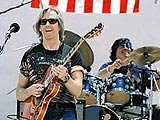
Seven years ago, when we started our Santana Tribute Band (Savor), we created a promotional video to show agents and entertainment directors what the band looked and sounded like. At that point, we hadn't played any gigs! So we shot the band -- live -- in a rehearsal studio. Later we cut in footage that various cable stations had given us from subsequent shows.

Of course, since then, there have been changes in band members; on the whole, I believe the band sounds better. And, after more than 100 gigs, we have more stage presence, as well.

So, fast-forward to 2010. We just finished a new video, and this one is a bit different from the first one, in the following respects:

1) It's shorter. Two-and-a-half minutes, as opposed to seven;
2) There are more songs (nine; the old one had six); they are:
- Black Magic Woman
- Oye Como Va
- Smooth
- Jingo
- She's Not There
- Savor
- Samba Pa Ti
- Guajira
- Europa
3) There are some "text panels" throughout; and, finally,
4) The band members are introduced.

I'd love some feedback on this. What do you think? Did we include everything we needed to, or is something missing?

Do you hear enough of each song to get the idea, or would longer clips be better?

Some of the video is a little "shaky;" is that a problem?

Please feel free to comment below, and let us know your thoughts!

Thanks.

Saturday, July 24, 2010

The Sparkle of Santana DVX Wine

What do you do when you've at least popularized (if not virtually invented) Latin rock, helped to develop an entire culture of amplifier technology, toured the world with a smokin' band for more than four decades, played for half a million people zonked out of your mind, and launched a career renaissance the like of which has not been seen in the history of the music industry?

You launch your own private wine label, of course!

As most people know, the first paragraph refers to Carlos Santana's ground-breaking musical style, first seen by a wide audience at Woodstock in 1969. Not to mention his involvement with Mesa Boogie amplifiers, the legendary Santana live show, and the phenomenal popularity of 1999's Supernatural.

What may not be quite as familiar, though, is the Santana DVX Sparkling Wine that was produced by the Mumm Winery in Napa Valley, California. Issued in 2000, the combination of Pinot Noir and Chardonnay vintages was the brainchild of Carlos, his then wife Deborah Santana, and winemaker Ludovic Dervin.

Of course, it was introduced to on a broader scope than it might otherwise have been, due to a little ditty titled, appropriately, "Santana DVX," by a rap/comedy band called The Lonely Island. Complete with clever, albeit raunchy, lyrics, the song became quite a smash in the social media-sphere.

Unfortunately, the wine was issued on a very limited basis, and is long gone. No word of a sequel has been released, although with this run Carlos Santana has been on, you never know!

Wednesday, July 14, 2010

Drummer Cindy Blackman to Wed Carlos Santana

It must have been a stunned crowd that witnessed Carlos Santana's very public proposal to this then girlfriend (now fiancee): drummer Cindy Blackman. Obviously a lot more than that audience bargained for In Tinsley, Park, Illinois, on the July 9, 2010 show of the Universal Tone Tour.

Blackman, although primarily a vetted jazz percussionist, is possibly best known for her 11-year stint with Lenny Kravitz. As such, she showed she was a master of groove as well as swing. This may be the general public's introduction to the groundbreaking drummer, but in the jazz scene, especially, she has long been a fixture.

And with numerous albums under her belt, she can claim status as a composer as well.

Her gig with Santana's band adds Latin rock music to her resume, and seems to be just another step in Blackman's self-proclaimed goal of virtuosity. Congratulations to the happy couple!

Tuesday, February 23, 2010

Gregg Rolie

Gregg Rolie

Legendary Vocalist/Keyboardist for Santana and Journey

Santana's 1999 Grammy phenomenon, Supernatural, has sold in excess of 25 million copies. It launched a rebirth of Carlos Santana's career leading to his artist-as-icon status. More recently, he has lent his name to a line of Santana perfumes and colognes, handbags, wine, Carlos by Carlos women's shoes, and more.

But this legendary status now enjoyed by Carlos wouldn't exist were it not for the hits still played on radio: "Evil Ways," "Black Magic Woman," "Oye Como Va," et al. Most of these songs were included on Santana's first two albums, Santana (often called Santana by Santana), and Abraxas.

At the heart of the sound of those classic records are the keyboard playing and vocals of a young musician named Gregg Rolie.

Still a teenager when he and Carlos formed what was at one time titled the "Santana Blues Band" and then finally simply "Santana," Rolie had a distinctive vocal style has been immortalized on those early albums. And he didn't stop there. He and band mate Neal Schon went on to form Journey, a band which initially achieved a cult status among musicians, and then became one of the world's leading pop rock groups.

Rolie wasn't just a vocalist who accompanied himself on keyboards, though. The powerful simplicity of his organ playing is evident in the iconic chord inversions that introduce Oye Como Va, the unusual note (a 9th) that kicks off his solo in Evil Ways, and many other parts. Playing keyboards is something many people do; really good keyboard players is a much smaller group. Creating keyboard parts (both rhythm and lead) that stick in people's mind is a rare skill indeed, and one at which Rolie excels.

To this day, Rolie can be heard on both keyboards and vocals in his own group, the Gregg Rolie Band. Touring the country and playing hits both old and new, Rolie and his band (which includes original Santana conguero Mike Carabello) embody much of the original sound of the early Santana songs that still resonate with listeners, 40 years later.

Tuesday, February 16, 2010

Neal Schon

Incredible Melodic Journey

There are a lot of excellent electric guitar players out there. When you narrow the field to guitar players who play parts that you remember long after the song is over, it shrinks noticeably. But at the very pinnacle of that group is this category: players so melodic that every "riff" they play is a hook that sticks with you for a long time.

One of the members of that very small cadre is Neal Schon.

He must have displayed that talent early, because at 15, he had Eric Clapton and Carlos Santana vying to bring him on tour. After a couple of years under the radar in Santana's band, Neal broke out on his own to form Journey with Santana band mate Gregg Rolie. It was a momentous career choice.

Beginning with the first note of the first song on the first Journey album, Schon has steadily created a catalog of memorable songs, parts, and solos that is mind-boggling. His unique chordal phrases form the basis of most Journey songs; his lead riffs and solos challenge the vocal lines for sheer melodic power.

For more than 30 years, Schon has built a body of work that is staggering in its sheer volume, not to mention quality. He has contributed to many other projects, and even been in other bands (Bad English, Hardline, Abraxas Pool, et al), but it is in Journey where his melodic gift is best exemplified.

Tuesday, February 9, 2010

Yamaha SG

One-Time Santana guitar

More than 10 years of photography have etched the image of Carlos Santana and his PRS Signature guitar into the public consciousness. The resurgence of Woodstock footage has served the same purpose for one of Santana's original guitars: a Gibson SG.

But the six years that Santana spent playing a much less known guitar -- the Yamaha SG -- have been, to a great deal, eclipsed. However, that guitar, played by Carlos during a pivotal point in his career, probably had a lot to do with what many people think of as the "Santana Sound." That is, a round, smooth-yet-beefy-tone, complemented by endless sustain.

Embodying the best of the features of Santana's two previous guitars, the SG and Les Paul (both by Gibson), the Yamaha SG175 was a thick, woody guitar with double cutaways in the body. Combined with his Mesa Boogie amp, it helped him develop the signature sound for which he is renowned today.

Actually, although the model number was SG175 at first, Carlos and Yamaha together modified it into it's eventual form, which was called the Yamaha SG2000. That is the guitar heard on the original recording of "Europa," "Open Invitation," and other classic Santana songs.

After Carlos had played the guitar for a while, it was "discovered" by other popular guitarists of the day, including Steve Cropper, Kerry Livgren (Kansas), and Mick Jones (Foreigner).

Recently, Yamaha has reissued the model as the SBG2000, as well as several other related models. It's a fitting tribute to the legendary status of the artist who originally helped the world see the quality of Yamaha guitars.

Friday, December 18, 2009

How Santana Music Influenced Me


During the years I've played guitar in a Santana Tribute band, people generally assume that I'm a huge Carlos Santana fan. It's true that I've always enjoyed his music (especially the first two albums, Santana by Santana and Abraxas), but since I didn't really learn any Santana songs in depth until decades into my guitar career, he didn't exert a noticeable influence on my guitar style.

Actually, short-time Santana band member and co-guitarist Neal Schon (of Journey fame) played a much greater role in my development as a 6-string slinger, as I have long admired his melodic finesses combined with technical prowess.

But I have never been able to really learn someone's music in detail without coming to appreciate it on a deeper level, and such has been the case with Santana's music. As a guitar player, I certainly comp his lick's note-for-note during the tribute band gigs. And although his playing style is different from mine, his flair for stripping a guitar line down to its essence has definitely inspired me.

One of the the things Carlos excels at is playing melodies that are harmonically simple but rhythmically complex. He does it so naturally that it's not generally noticeable, but try to mimic his style and you'll find you really have to pay attention to your phrasing.

Additionally, I have taken a cue from the original Santana band, as a unit. Having always been a devotee of chordally complex music, I was delighted to study how Santana could take, not a 3-chord, not a 2-chord, but a 1-chord song ("Jingo"), and use a dynamic arrangement to keep it interesting. Awesome!

Even the most popular of Santana songs -- their re-make of Tito Puente's classic song "Oye Como Va" -- employs a simple 2-chord progression (i and iv) that never changes. Yet the arrangement is so interesting that the song never loses its trademark drive.

When writing the songs for my band Savor's CD, ¡Moviendote!, I tried to utilize those principles, as well as techniques gleaned from years of listening to and writing many different styles of music. Since the instrumentation is the same (guitar, bass, keyboards, drums, timbales, congas, hand percussion), it can't help but bear a common thread with Santana. But I see it as just one of the facets that make up a musical menage.